
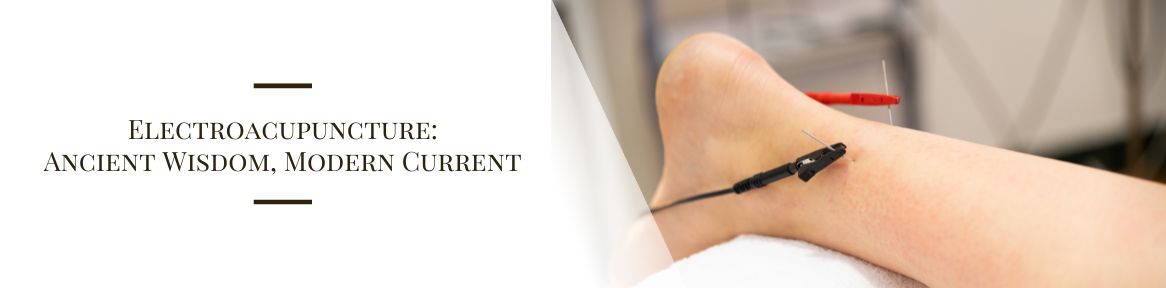
The clinic was quiet except for the soft hum of a small device on the treatment table. A runner lay comfortably, acupuncture needles placed along her calf and lower back to address chronic pain that kept her from her regular running routine.
Because of the chronic and nagging injury, she turned to acupuncture to find healing. But it wasn’t quite what she expected. Rather than simply resting with the needles inserted, the practitioner gently attached thin leads to several of the needles and turned on a device that sent a gentle electrical current through them. A subtle pulsing sensation began, almost like tiny waves moving through her muscles. Within minutes, she felt her body responding, warming, releasing.
This therapy was electroacupuncture, a technique blending the longstanding principles of traditional acupuncture with modern electrical stimulation.
What Is Electroacupuncture?
Electroacupuncture is a therapeutic modality in which mild electrical currents are passed between pairs of acupuncture needles. These currents stimulate acupuncture points more consistently and often more deeply than manual needle manipulation alone.
The technique originated in the mid-20th century in China as practitioners explored ways to enhance classical acupuncture treatments, especially for severe pain, paralysis, and neurological conditions. Today, electroacupuncture is used globally in both integrative medicine and rehabilitation clinics.
The underlying philosophy remains rooted in Traditional Chinese Medicine (TCM):
- Qi (vital energy) should flow smoothly through the body’s meridians.
- Blockages or deficiencies in this flow can lead to discomfort or illness.
- Stimulating specific points helps restore balance, function, and natural healing.
The addition of electrical stimulation simply enhances this therapeutic influence, strengthening the signaling between the nervous system, muscles, and connective tissues.
How Electroacupuncture Works
From a biomedical perspective, electroacupuncture can be understood through its effects on the nervous system and cellular function.
Research shows that electroacupuncture can:
- Increase the release of endogenous opioids, such as endorphins and enkephalins, reducing pain perception.
- Modulate inflammatory pathways, reducing cytokines that contribute to chronic inflammation.
- Improve microcirculation, which supports tissue repair and muscle recovery.
Electrical stimulation also activates specific nerve fibers. Low frequencies (2–4 Hz) tend to stimulate the release of endorphins and enkephalins, while higher frequencies (80–120 Hz) activate dynorphins. Skilled practitioners adjust frequency based on the therapeutic goal, whether relaxing muscle tension or improving nerve function.
Consider this example of a classical guitarist who developed ulnar nerve entrapment from years of practice. Traditional rest and physical therapy helped only partially, so the guitarist looked into acupuncture and was introduced to electroacupuncture. The practitioner placed needles near the elbow, wrist, and shoulder, attaching electrodes that delivered gentle rhythmic pulses.
Over the weeks, the guitarist noticed not only decreased pain but improved dexterity. The pulses felt like the hand was “relearning” how to move without tension, as though the nervous system was being rewired.
This is one of the unique strengths of electroacupuncture: It doesn’t force healing—it reminds the body how to do what it already knows how to do.
Conditions Commonly Treated with Electroacupuncture
Electroacupuncture is used for a wide range of conditions, especially those involving pain, muscle dysfunction, or nerve impairment. Research supports its use in:
Electroacupuncture is not a one-size-fits-all therapy. The treatment protocol — needle placement, frequency, intensity, and duration — is uniquely tailored to the individual.
What to Expect During a Session
A typical electroacupuncture session may involve:
- A brief consultation to determine the root cause of symptoms.
- Needle placement at precise acupuncture points.
- Connection of small clips or leads to select needles.
- A gradual increase in electrical stimulation until a gentle pulsing sensation is felt.
Most sessions last 20–40 minutes, and many patients find the experience deeply relaxing.
Sensations vary:
- Some feel gentle tapping or warmth.
- Others feel a soft vibration or muscle twitch.
- Pain is not expected but if discomfort occurs, the intensity is adjusted.
Is Electroacupuncture Safe?
When performed by a licensed acupuncturist, electroacupuncture is considered very safe. The electrical current used is low; far less than what is used in physical therapy devices like TENS units.
However, caution is required in cases involving:
- Pacemakers
- Seizure disorders
- Pregnancy (certain points should be avoided)
Always consult a qualified practitioner.
Electroacupuncture in a Modern Wellness Landscape
As more people seek alternatives to medication-based approaches for pain, anxiety, and chronic conditions, electroacupuncture offers something uniquely powerful:
- It is evidence-supported.
- It is minimally invasive.
- It activates the body’s built-in healing intelligence.
It also bridges worlds:
- The ancient world of Qi and Meridians.
- The modern world of neurophysiology and pain science.
In a culture that often looks for quick solutions, electroacupuncture encourages something more meaningful: active collaboration with the body’s natural systems.
As more people explore integrative medicine and the body’s capacity to heal naturally, one question remains: What might your life look like if your body had the support and space to remember its own healing potential?
